

We have all done it. We open our AI coding assistant, type a vague command like "implement OAuth login" or "refactor this database handler", and hit enter.
Immediately, the autonomous agent starts spinning. It refactors three files, creates two new utility modules, updates the dependencies, and generates a massive diff. You compile, and the build fails. You realize the AI made a dozen unchecked assumptions about your architecture, secret keys, and routing structures.
Vague prompts are the absolute enemy of autonomous coding. To fix this, we need to change how we interact with our agents. Instead of letting them guess, we need to let them interrogate us.
Enter the Grill-Me paradigm.
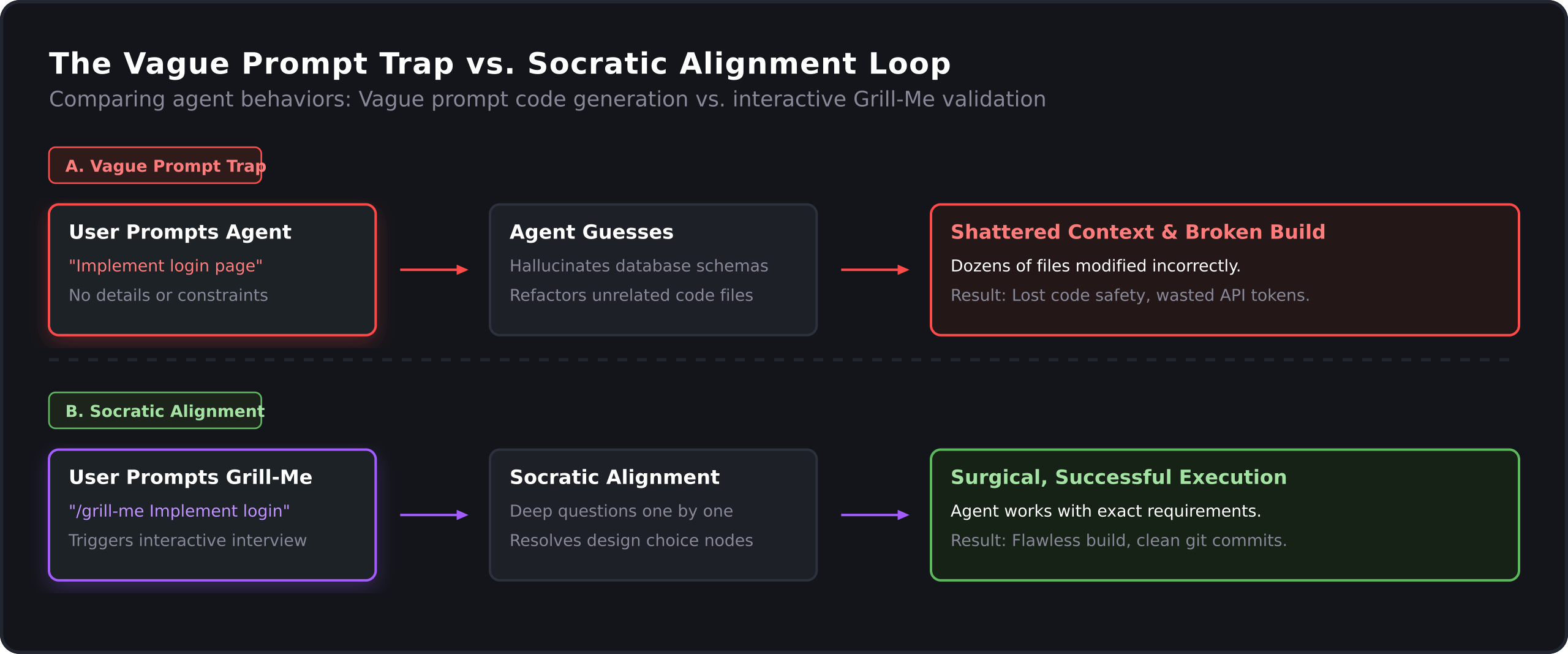
Figure 1: Comparison of execution cycles: Vague prompts lead to broken builds, whereas Socratic alignment loops produce clean, surgical code edits.
Originally developed as part of Matt Pocock's skills repository, the grill-me skill shifts the human-agent relationship from black-box execution to an interactive Socratic alignment loop.
The Socratic Flow: How the Grill Works
The mechanics of the grill-me skill are intentionally restrictive and highly disciplined:
One Question at a Time: The agent is forbidden from dumping a list of questions. It must ask exactly one probing question at a time to keep your cognitive load low.
Recommended Answers: For every question asked, the agent must propose a suggested answer (e.g., "Recommended: Use the existing auth helper in utils.js"). You can accept it with a simple yes or refine it with your own input.
Codebase Awareness: The agent is instructed to explore your codebase first. It should never ask you questions that can be answered by looking at your files.
This creates a systematic decision tree. You resolve dependencies one by one before a single line of code is edited.
The Developer's Lens: Resolving Plan Confusion
As developers, we often start tasks feeling slightly confused or overwhelmed. We know the high-level goal, but we haven't mapped out the edge cases or implementation details.
When you prompt an agent with /grill-me, it forces you to pause.
By interviewing you, the AI acts as a sounding board. As you respond to its questions, you are forced to clarify your own requirements. You decide on routing parameters, database constraints, and error boundaries before writing code.
Instead of staring at a blank editor trying to plan, you simply answer a sequence of simple prompts. By the time the interview is complete, you and the agent share a perfect, validated blueprint of the task.
The Agent's Lens: Preventing Wasted Autonomy
From the AI agent's perspective, vagueness is a recipe for context drift and token waste.
When an agent doesn't have clear requirements, it is forced to hallucinate constraints. It might over-engineer a simple solution or refactor unrelated files. Once it takes a wrong turn, it gets stuck in feedback loops, burning through your API limits.
Grilling the user beforehand acts as a guardrail. It locks down the implementation parameters (like library versions, error formats, and target paths). This keeps the agent's edits surgical, reduces token usage, and increases the success rate of the build on the first attempt.
Getting Started with Grill-Me
You can add the grill-me skill to your agent's configuration using the following command:
npx skills add https://github.com/mattpocock/skills --skill grill-me
Once installed, simply prefix your complex tasks with /grill-me (e.g., /grill-me I want to add a caching layer to our API routes) to initiate the interview.
By shifting the starting line from writing code to answering questions, you eliminate guesswork, save your API budget, and build a clearer understanding of your own projects.
Thanks for reading. See you in the next experience.