
Debugging Push SDK on Office WiFi Networks
A real-world case study of deploying a face recognition attendance device and diagnosing WiFi firewall issues blocking cloud Push SDK

Deploying a face recognition attendance device sounds simple—connect it to WiFi, point it to the server, and you're done.
In reality? Network policies can turn a 30-minute setup into a full debugging session.
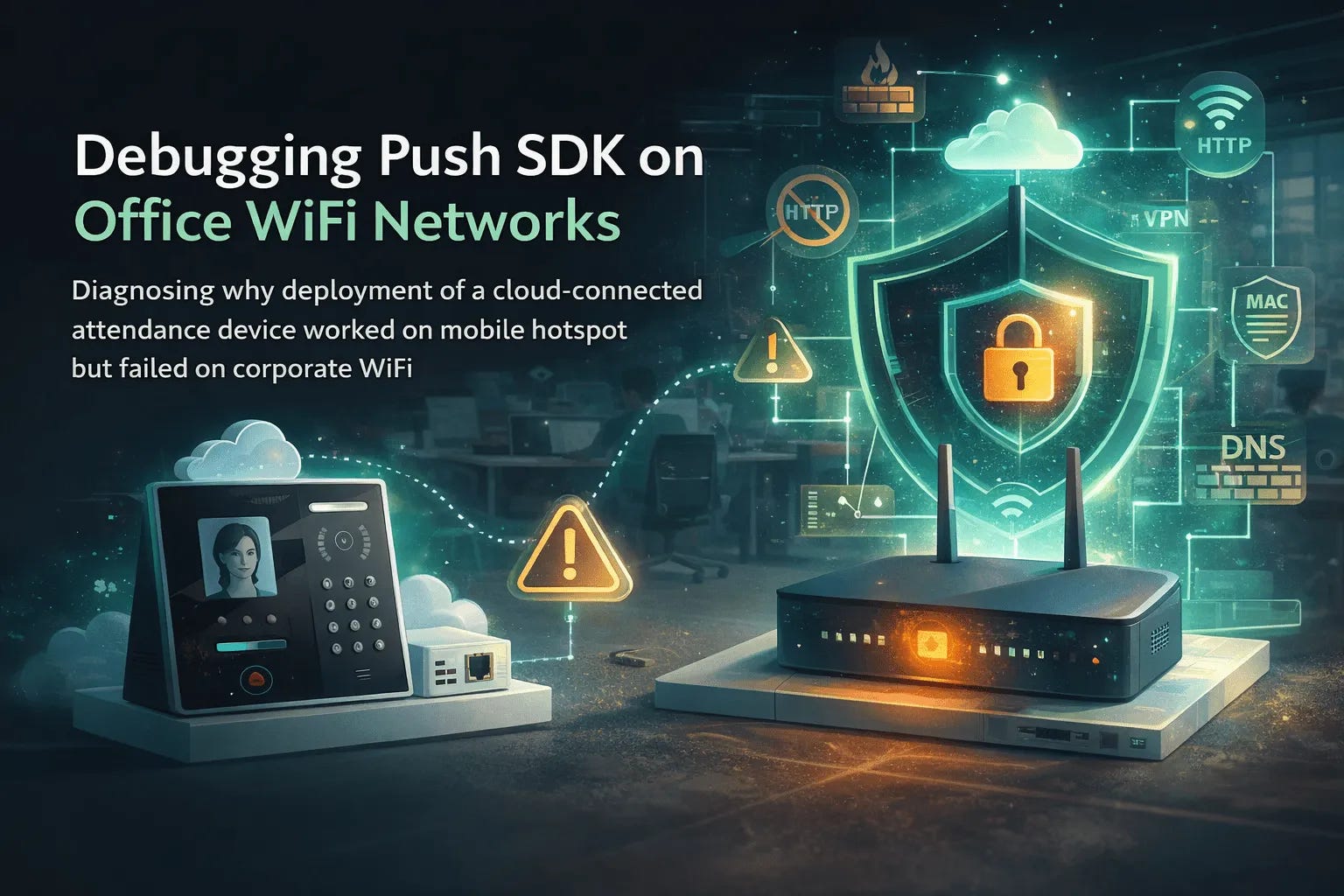
This article documents a real-world deployment of a cloud-connected attendance device, the network issues encountered, and the technical reasoning behind the final diagnosis.
1. Device Overview
The deployed device is a face recognition attendance terminal with:
WiFi (2.4G)
HTTP / HTTPS support
Push SDK integration
Local Web UI configuration
Cloud server connectivity via custom port
Network Capabilities
DHCP or Static IP
DNS configuration
Custom HTTP push port
Push SDK server configuration
This type of device behaves similarly to an IoT endpoint rather than a traditional PC client.
2. Deployment Architecture
Cloud Setup
The device was configured with:
Domain:
fvivo.onlineProtocol: HTTP
Port: 8001
Push SDK: Enabled
The cloud endpoint responded successfully via browser:
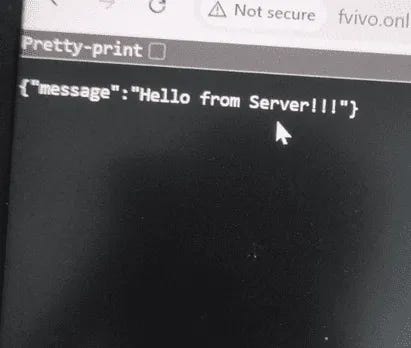
Response:
{"message":"Hello from Server!!!"}
So the server was confirmed operational.
3. Initial Symptoms
When connected to:
✅ Mobile Hotspot
Push SDK → Online
Cloud sync → Working
❌ Office WiFi
Push SDK → Offline
Internet available
DNS resolving
Port reachable from PC
This discrepancy was the key clue.
4. Network Testing & Validation
4.1 Basic Connectivity
From office WiFi:
ping 8.8.8.8
Internet reachable.
4.2 Port Test
Test-NetConnection fvivo.online -Port 8001
Result:
TcpTestSucceeded : True
So:
Port 8001 NOT globally blocked
DNS working
Outbound TCP allowed
Yet the device still showed:
Push SDK Status: Offline
5. Why PC Works but Device Fails
This is where deeper network behavior matters.
Enterprise WiFi networks often apply:
MAC-based policy rules
VLAN segmentation
IoT isolation
Layer 7 filtering
Deep Packet Inspection (DPI)
Application-based firewall rules
PC traffic is recognized as normal browser/client behavior.
IoT traffic (like Push SDK HTTP posts) may be:
Classified differently
Subject to stricter outbound filtering
Blocked by security profile
Even when the port is technically open.
This explains why:
PC → can access port 8001
Device → cannot establish session
Hotspot works because:
No L7 inspection
No security policy
No device classification
6. Why It Was NOT a Port Issue
Many assume port blocking first.
However:
Port 8001 reachable from PC
Server confirmed live
DNS resolving
HTTP response verified
Therefore, traditional firewall port block was ruled out.
The issue was policy-level filtering, not transport-level blocking.
7. The Most Likely Root Causes
Based on behavior:
IoT isolation profile applied to unknown MAC
VLAN separation for non-registered devices
Application filtering for non-browser HTTP clients
Security rule limiting outbound traffic by device type
In enterprise networks, security layers are often invisible to end users.
8. How to Communicate With IT (Best Practice)
Instead of saying:
“Port 8001 is blocked.”
A better technical request is:
The attendance device cannot establish outbound TCP session to
fvivo.online:8001when connected to office WiFi, but works via mobile hotspot. PC connectivity test to the same endpoint succeeds. Please check if there is any MAC-based policy, VLAN isolation, or application filtering affecting this device.
This approach avoids blame and invites structured investigation.
9. Lessons Learned
🔹 1. IoT devices are treated differently
Enterprise WiFi does not treat all clients equally.
🔹 2. Port open ≠ Traffic allowed
Firewall inspection can allow a port while still blocking specific traffic patterns.
🔹 3. Always compare environments
If hotspot works and office WiFi does not: The network is the variable—not the device.
🔹 4. Push SDK over HTTPS is safer
Using HTTPS (443) significantly reduces filtering issues in enterprise environments.
10. Recommended Best Practices
Use HTTPS (443) whenever possible
Ask IT to whitelist device MAC address
Document server IP and domain
Keep network architecture diagrammed
Avoid custom ports if corporate firewall policies are unknown
Final Opinion
Deploying biometric attendance devices is no longer just a hardware task—it is a networking task.
Modern enterprise networks prioritize security, often at the expense of IoT compatibility.
Understanding network layers (L3 vs L7 filtering) is critical for successful deployment.
If a device works on hotspot but fails on corporate WiFi, the network policy is almost always the hidden variable.
If this case study helped you, feel free to share it or follow for more real-world deployment insights.