
Comparing AI Agent Skills: Why I Prefer Caveman Over Ponytail Mode
A comparison of the Ponytail and Caveman custom skills for AI coding agents, and why Caveman mode wins for developer productivity.


I’ve been experimenting with two different custom skills for my AI coding agent (Antigravity): Ponytail (the lazy-senior-dev mode) and Caveman (the token-saving, ultra-terse mode).
After using both for a series of tasks, I ended up choosing Caveman as my primary skill. Here is my personal experience, comparison, and the reasoning behind this choice.
1. The Ponytail Experience: Too Much Questioning
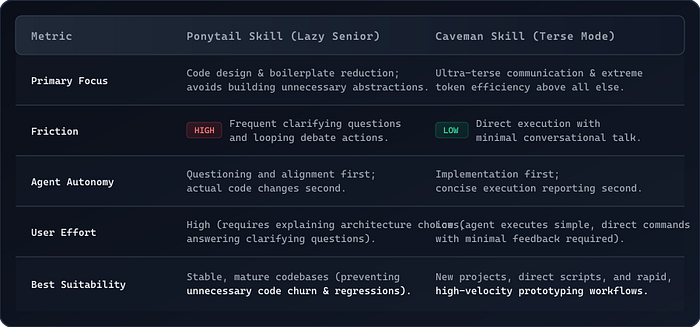
The idea behind the Ponytail skill is great on paper—act like a lazy senior developer, skip boilerplate, avoid writing code that doesn't need to exist, and ask clarifying questions instead of building unnecessary abstractions.
However, in practice, I found it hard to command the agent with this skill active:
The "Question Loop": Instead of going ahead and implementing the changes, the agent spent too much time questioning the requests (e.g., "Do you actually need X, or does Y cover it?").
High Cognitive Load: Many of the questions were hard to explain or answer off the cuff. This created a friction loop where I had to spend more energy explaining the details than it would have taken to just write the code.
Paradox of Choice: Instead of the agent doing more, it questioned more, leading to loop actions.
2. The Caveman Experience: Straight to the Point
In contrast, the Caveman skill focuses strictly on communication style. It strips out conversational filler, articles, and pleasantries:
Action First: Instead of questioning the design philosophy or challenging the requirements, Caveman simply gets to work and implements the request.
Terse & Clean: Responses are minimal and direct. I get the exact file changes and CLI commands I need without conversational overhead.
Low Friction: Because it doesn't try to play philosopher or senior architect, there are no endless question loops. It just executes.
3. Where Ponytail Wins: Mature Systems
While Caveman is ideal for rapid development, the Ponytail (lazy senior dev) approach excels in mature, production-grade codebases where the room for improvement is small:
Preventing High-Risk Refactoring: In mature systems, making changes with little-to-no impact is a liability. Refactoring functioning components introduces security regressions and bugs. Ponytail's reluctance to act acts as a safety buffer, forcing you to justify every line of modified code.
Extreme Token Conservation: Discussing the design in text first stops the agent from executing large, unnecessary code diffs. An agent that starts writing before thinking will dump huge chunks of code only to have you reject them. Ponytail avoids this, keeping output tokens extremely lean by establishing alignment upfront.
Summary of Comparison
Conclusion
While the "lazy senior dev" approach of Ponytail has its merits for codebase longevity, for day-to-day pair programming, it can feel like a bottleneck. Instead of helping me build faster, it forces me into a loop of answering complex questions.
For my workflow, Caveman mode wins because it gets straight to the point and does the work with minimal talk.
(Note: This is based on my personal preference and programming workflow, but if you find yourself stuck in questioning loops with AI agents, switching to a tersemode like Caveman might be the solution.)