
Building Custom ERP Superapps with Rust
An architectural look at building type-safe, high-performance custom ERP systems and superapps in Rust, and how they compare with Odoo and SAP.


Traditional ERP and CRM suites carry a heavy toll: bloated cloud infrastructure, frequent runtime crashes, and loose type-safety in dynamic languages like Python or PHP. For scaling enterprises and high-load "superapps," these inefficiencies map directly to lost revenue and system vulnerabilities. In this lab, we examine why custom development in Rust has transitioned to a competitive, production-ready strategy, unpacking how its type system secures complex business logic and analyzing the trade-offs of custom systems versus buying standard platforms.
Technical Architecture of a Rust-Based ERP
To understand why a Rust ERP is fast and secure, we must look at its core architecture. Below is the blueprint of a typical custom enterprise suite, utilizing Axum for web routing, SQLx for database interaction, and Askama for type-safe HTML rendering:
    [ HTTP Clients / Web Browsers ]
                 │
                 ▼  (gzip-compressed HTTP/2)
    [ Axum Web Server (Tokio Runtime) ]
                 │
        ┌────────┴────────┐
        ▼                 ▼
   [ Askama HTML ]   [ SQLx Query Engine ] ──(Compile-Time Checks)──> [ PostgreSQL ]
   (Compiled to Rust)     │
        │                 ▼  (Prepared Statements)
        │            [ DB Pool Manager ]
        ▼
   [ Static HTML Response ] (rendered in < 1ms)
1. Compile-Time HTML Compilation (Askama)
Unlike traditional template engines (like Jinja, Blade, or PHP) that parse HTML files from the disk at runtime, engines like Askama compile HTML templates directly into Rust code at compile time.
Zero Runtime Overhead: Rendering an HTML page is reduced to a series of fast string writes in memory, completing in microseconds.
Type-Safe Templates: If a template references a variable or a struct field that does not exist or has the wrong type, the compiler throws an error. It is impossible to deploy a page with broken variables or typos to production.
2. Compile-Time Checked SQL (SQLx)
SQLx is a database library that connects to a live database schema during compiling.
Schema Verification: If you write
SELECT name, price FROM itemsbut the columnpricewas renamed in a migration tounit_price, the compilation fails.No Runtime Database Mismatch: Schema synchronization issues are caught on the developer's machine or in CI, guaranteeing that database queries in production never fail due to syntax errors.
3. Single-Binary Deployment
The entire ERP (web server, template engine, background job worker, email dispatcher, and database handlers) compiles into a single, statically linked binary. It starts in milliseconds, runs with an initial RAM footprint of under 20MB, and requires no external interpreter, virtual machine, or runtime framework to manage.
Case Study: The SCM Procure-to-Pay State Machine
One of the most complex components of an ERP is the Supply Chain Management (SCM) workflow. In a Procure-to-Pay flow, materials must move through a highly regulated chain of states:
[ PR Created ] ──> [ Sourcing/RFQ ] ──> [ PO Draft ] ──> [ Finance Lock ] ──> [ PO Issued ] ──> [ Delivery/QC ] ──> [ Invoice/Lunas ]
In traditional suites, tracking these states relies on database integer flags or string fields, which are prone to bugs where a Purchase Order (PO) might be issued before it is approved, or an invoice is paid before the items clear Quality Control (QC).
Algebraic Data Types for Workflow Integrity
Rust uses algebraic data types (enums with associated data) to represent business states. This prevents invalid states from ever being compiled:
pub enum POStatus {
    Draft,
    AwaitingApproval { requested_at: chrono::DateTime<chrono::Utc> },
    Approved { approved_by: uuid::Uuid, budget_lock_id: uuid::Uuid },
    Issued { issued_at: chrono::DateTime<chrono::Utc>, ack_evidence_path: String },
    Closed,
}
By structuring states this way, the compiler forces developers to handle the associated data. You cannot mark a PO as Approved without providing the ID of the manager who approved it and the ID of the budget lock reserved in the database.
The Budget Gate Pattern
A common requirement in corporate finance is the budget reservation gate: any purchase order above a certain threshold (e.g., 100M IDR) must undergo a hard verification gate.
Here is how a custom Rust handler enforces this validation:
pub async fn issue_purchase_order(
    State(st): State<AppState>,
    Extension(user): Extension<BusdevUser>,
    Path(po_id): Path<Uuid>,
) -> AppResult<Response> {
    if !user.can_manage_scm() { return Err(AppError::Forbidden); }

    // Fetch PO details
    let po: PurchaseOrder = sqlx::query_as(
        "SELECT id, total_amount, status FROM scm_purchase_orders WHERE id = $1"
    ).bind(po_id).fetch_one(&st.pg).await?;

    // Hard threshold gate check
    if po.total_amount >= 100_000_000 {
        let budget_approved: bool = sqlx::query_scalar(
            r#"SELECT EXISTS (
                 SELECT 1 FROM scm_budget_locks
                  WHERE released_po_id = $1 AND status = 'approved'
               )"#
        ).bind(po_id).fetch_one(&st.pg).await?;

        if !budget_approved {
            return Err(AppError::BadRequest(
                "Aksi tidak bisa diproses: PO >= Rp 100.000.000 wajib memiliki Form Approval Budget yang disetujui.".into()
            ));
        }
    }

    // Proceed to issue PO...
    Ok(Redirect::to(&format!("/scm/po/{}", po_id)).into_response())
}
Because the gate is enforced in a compiled, synchronous block at the database transaction layer, it is impossible for race conditions or UI bypasses to issue high-value POs without budget coverage.
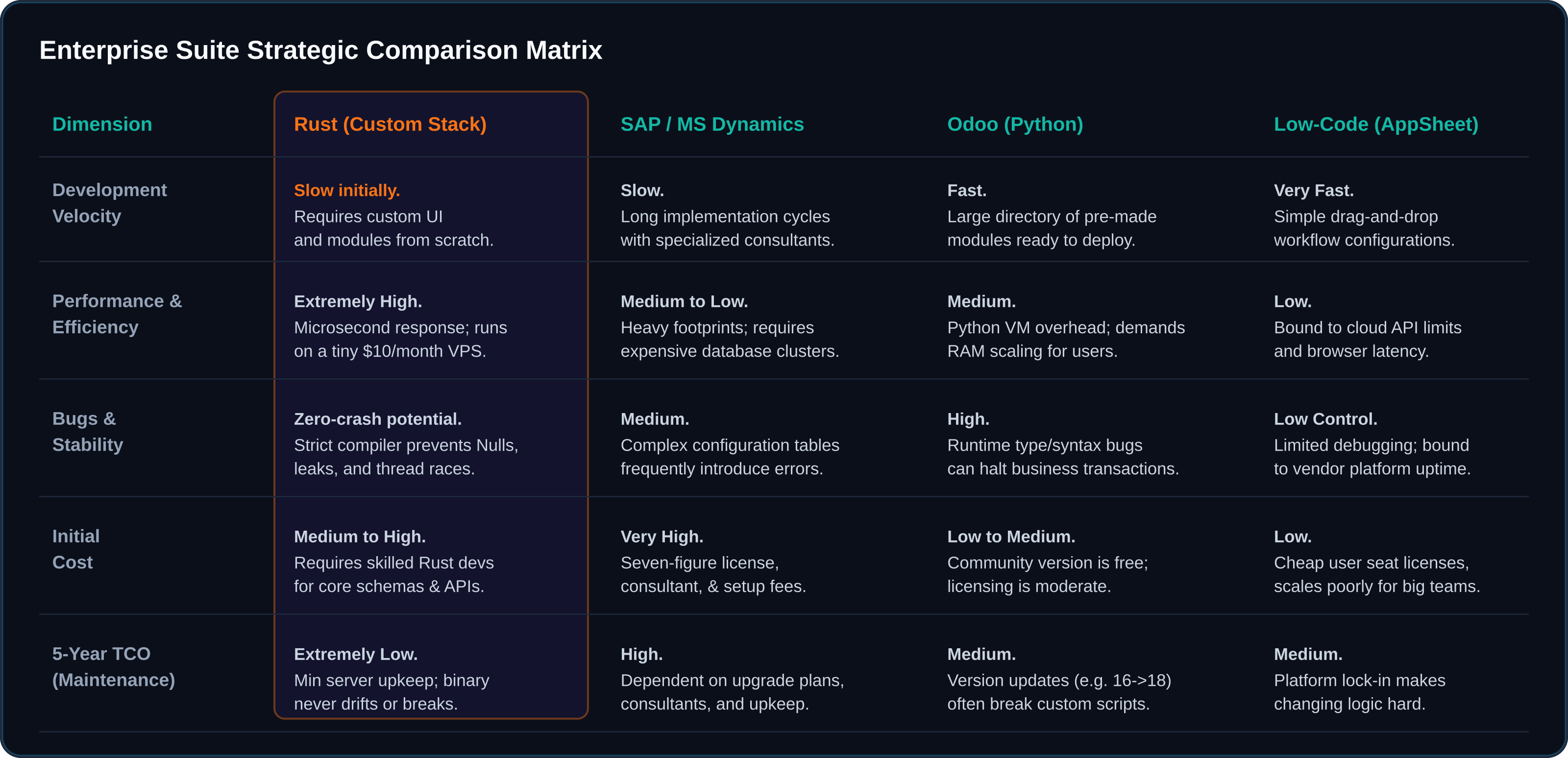
Rust vs. The Giants: Strategic Trade-Off Matrix
When deciding whether to build a custom ERP/CRM in Rust or buy an off-the-shelf system, technical organizations must weigh several critical dimensions:
Identifying the Sweet Spot
Choose SAP/Dynamics if your organization is a legacy multi-national with thousands of non-technical staff requiring standard, pre-approved accounting schemas, and you have the budget for long implementation timelines.
Choose Odoo if you need a standard store or generic CRM with minimal customization and want a working prototype in under 2 weeks.
Choose Custom Rust Stack if you are building a custom superapp, a high-transaction logistics system, or an ERP/CRM that requires unique business logic, instant performance, and strict data security, and you want to keep long-term server infrastructure costs near zero.
The Integration and Maintenance Gap: Plug-and-Play Ecosystems vs. Custom API Engineering
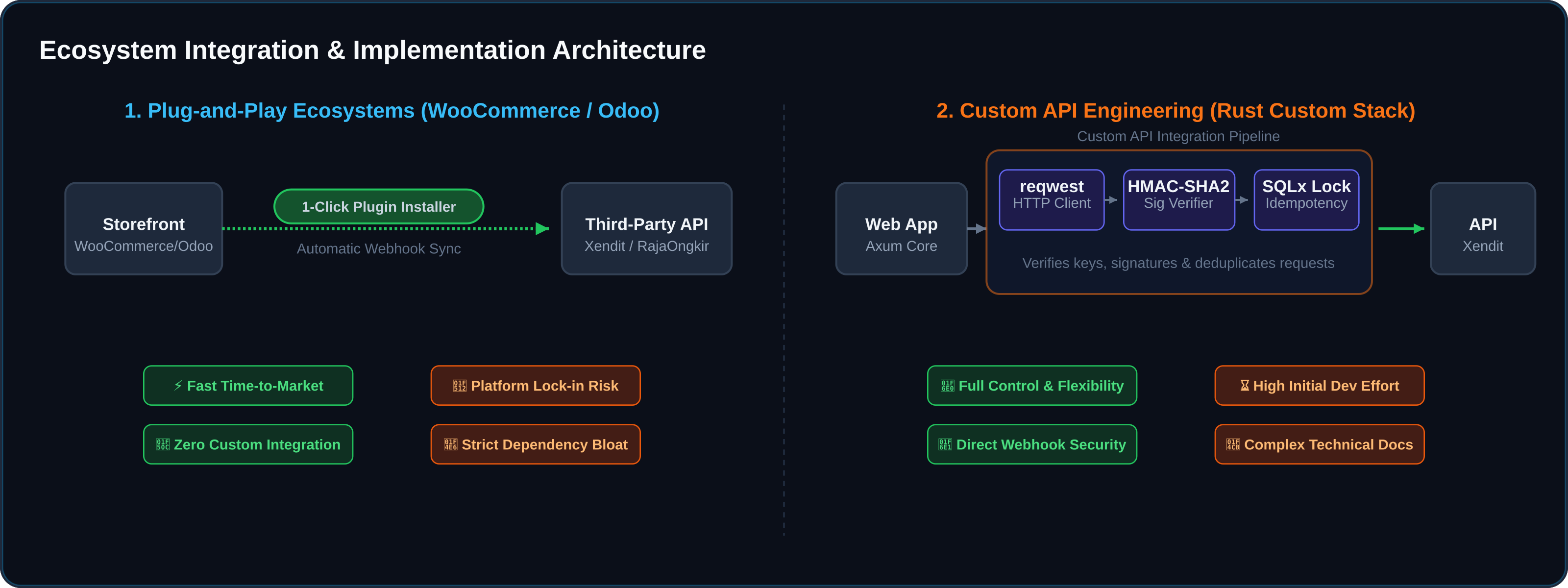
When evaluating a custom Rust stack against pre-built platforms, the most immediate hurdle is ecosystem leverage and integration velocity.
1. The Power of Off-the-Shelf Ecosystems
For standard transactional systems—such as an online storefront—platforms like WooCommerce or Odoo offer an unbeatable time-to-market advantage.
Plug-and-Play Connectors: Connecting a payment gateway (e.g., Xendit) or a shipping cost API (e.g., RajaOngkir) is a matter of installing a pre-built plugin, entering API keys, and toggling a switch. Webhooks, checkout pages, and customer notifications flow smoothly out of the box because the platform has already solved these integration details.
Odoo & SAP Adaptability: Odoo has a massive App Store with thousands of community-maintained modules. SAP provides pre-certified corporate banking adapters for major global institutions.
Attempting to rebuild these standard, third-party integrations in a custom Rust codebase is a waste of engineering resources. A custom stack should only be selected when your core business workflows are proprietary, highly complex, or require strict, type-safe budget verification gates that off-the-shelf plugins cannot enforce.
2. The Custom API Engineering Overhead
In a custom Rust ERP/CRM, third-party integrations require manual development. Connecting to a payment gateway means you must write your own HTTP clients using libraries like reqwest, design deserialization structures for API payloads, manually verify webhook signatures to prevent fraud, and build database-level idempotency checks to avoid double-processing.
While this manual approach grants you complete architectural control and isolates your system from third-party bugs, it demands significant initial development effort.
3. Developer Portability and Hand-Off
A frequent concern with custom systems is support: Who is responsible for the codebase if the original developer leaves?
Ecosystems like WordPress, Odoo, or Laravel have massive pools of developers, making hiring replacements simple. However, these dynamic codebases often suffer from implicit magic and messy, unstructured extensions, making it difficult for new developers to safely refactor code.
Rust flips this dynamic. While the hiring pool is smaller, Rust developers are generally higher-skilled on average. Because the Rust compiler behaves as a continuous linter that strictly enforces ownership, type-safety, and exception handling at the language level, it prevents developers from writing unstructured "spaghetti" code. The language's explicit nature naturally leads to a highly readable, self-documenting codebase, making the technical hand-off cleaner and less risky than in dynamic, loosely-typed languages.
The Unseen Advantage: Why Rust is the Ultimate Codebase for AI Agents
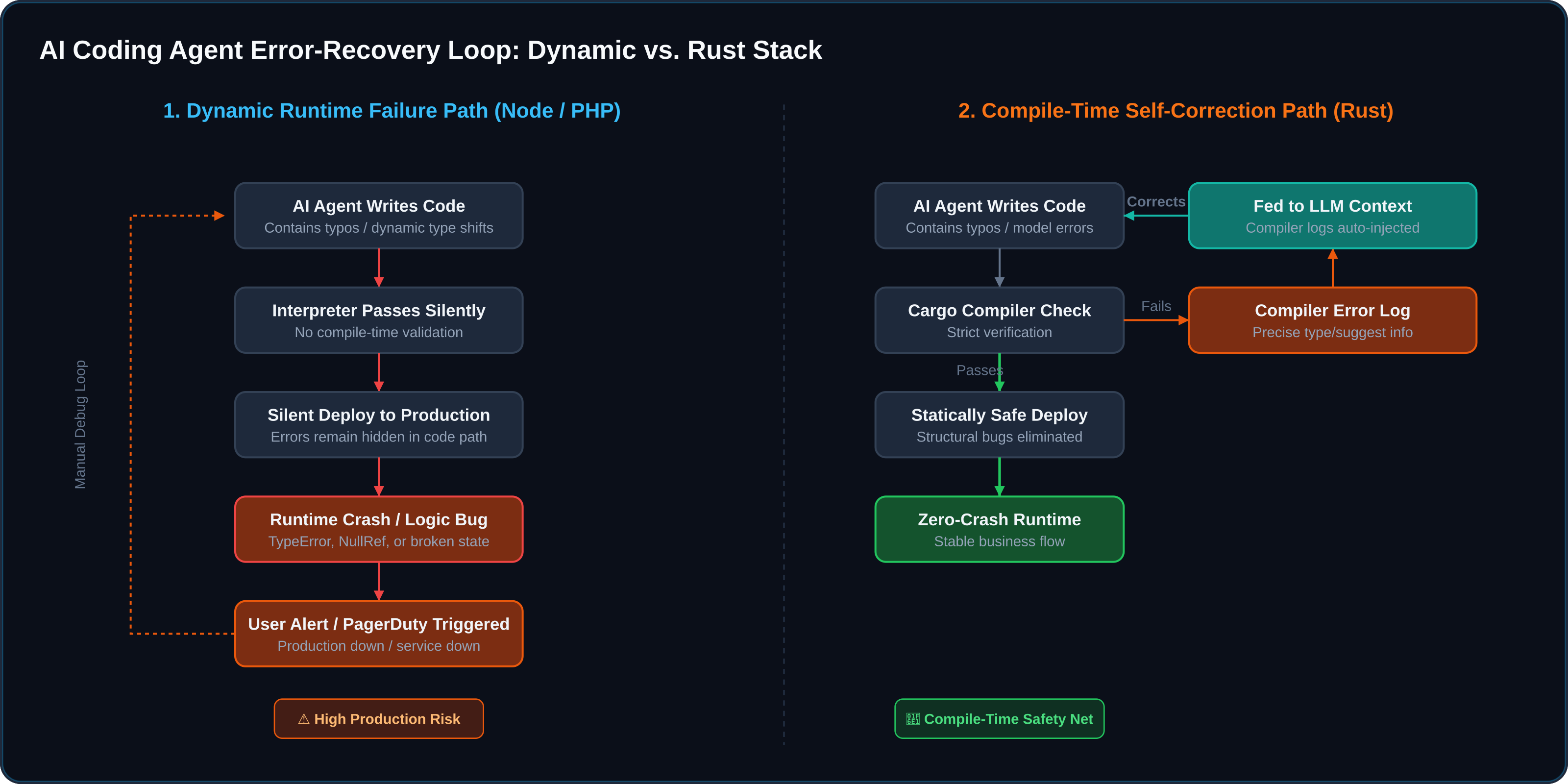
In the modern enterprise, writing code is no longer a task reserved solely for human engineers. Increasingly, software systems are maintained, patched, and audited by AI Coding Agents. When assessing a technology stack for the next 5 to 10 years, a CTO must ask: How easily can an AI agent read, understand, and safely modify this codebase?
Here, Rust has a massive, structural advantage over dynamic, framework-heavy ecosystems like Node.js or PHP (Laravel):
1. The Compiler as an AI Self-Correction Loop
When an AI agent writes code in JavaScript or PHP, a typo, dynamic type error, or subtle logic shift will pass without a sound. The code will execute, and the bug will only be discovered when it crashes in production or fails a runtime test.
In Rust, the compiler acts as a strict, compile-time gate. If the AI agent introduces a lifetime issue, a type mismatch, or misses a variant in an enum branch, the Rust compiler fails immediately. More importantly, Rust's error messages are notoriously precise—often pointing to the exact line, explaining the rule violated, and suggesting the exact fix. This provides the AI agent with a tight, deterministic feedback loop, allowing it to compile, read errors, self-correct, and verify structural correctness before a single line of code is pushed to version control.
2. Zero "Magic" and Explicit Context
Frameworks like Laravel or NestJS (Node) rely heavily on runtime magic—facades, global service containers, dynamic reflection, and runtime dependency injection. While this saves initial keystrokes for human developers, it degrades an LLM's reasoning. An AI agent scanning a file often cannot resolve where a class is injected, what global middlewares are active, or how a route helper is dynamically resolved.
Rust code is explicit by design. Imports are clear, dependencies are declared at the top of the file, and types are strongly declared. An AI agent reading a Rust function has 100% of the context it needs inside its prompt window. There are no hidden behaviors or implicit dynamic assumptions.
3. Simpler Dependency Structures
A typical Node.js or Laravel project carries a massive tree of transitive dependencies (the infamous node_modules or vendor folders), consisting of hundreds of small, single-purpose packages. For an AI agent, navigating this dependency sprawl is chaotic. Upgrades to packages can break compatibility in subtle, untyped ways.
Rust’s ecosystem relies on highly cohesive, well-defined crates (like Axum, SQLx, and Tokio). The explicit compiler contracts between crates mean that an AI agent can upgrade or refactor modules with high confidence that it won't trigger silent, cascading failures in untyped portions of the codebase.
The New Trade-Off: AI Dependency and Hallucinations
It is critical to note that while building with Rust simplifies the codebase for AI agents, it introduces a new kind of dependency: dependency on the AI agent itself.
AI models are probabilistic; they can hallucinate, show overconfidence, and output incorrect assumptions, even when equipped with precise developer guidelines or MCP server tools. However, this is where Rust's compiler proves invaluable. In loosely-typed dynamic languages, an AI's hallucination or logic error can easily slide past static analysis and crash at runtime under specific production requests. In Rust, the compiler behaves as a hard boundary. If the AI hallucinates a non-existent method, violates memory ownership, or makes incorrect type assumptions, the build fails immediately.
This shifts the AI's probability of error from a production risk to a compile-time filter. Technical teams must not treat AI as a fully autonomous silver bullet, but rather use Rust's strict compiler as the ultimate structural guardrail to keep AI errors isolated and easily debugged during the development loop.
Conclusion
Building an enterprise ERP or CRM in Rust requires a shift in engineering mindset: you trade initial development speed for permanent reliability, security, and performance. In this lab, we demonstrated that type-safe state machines, compile-time SQL validation, and low-footprint single-binary architecture offer a robust alternative to bloated off-the-shelf suites. For organizations building modern web platforms and superapps, investing in custom Rust services is a strategic move that pays off exponentially in operational stability and long-term cost reduction.
Thanks for reading. See you in the next lab.