


AI reconnaissance becomes dangerous when one exposed component explains the rest of the stack. A model registry can reveal artifact paths. A notebook can reveal workflow assumptions. A vector database can reveal which private documents may enter prompts. That metadata is enough to plan the next move, even before exploitation.
This is a defensive article, not a challenge walkthrough. It does not include task answers, target IP addresses, flags, credentials, proprietary lab text, or step-by-step solutions from any training platform.
My Short Version
If I had one day to reduce AI reconnaissance risk, I would not start with a new AI firewall. I would start with the boring controls that remove the easiest map:
put model registries, notebooks, and dashboards behind SSO
block public listing of model artifacts
disable unauthenticated metadata APIs
remove long-lived tokens from notebooks
log model listing, schema inspection, and artifact download events
The model endpoint is only one part of the target. The attacker wants the relationships around it: where models live, which data feeds them, which identity can read artifacts, and which service can promote a version into production.
Where the Stack Leaks Metadata
A practical AI system usually has more than a model server:
inference endpoint
model registry
experiment tracking service
notebook workspace
vector database
artifact bucket
logs and traces
service accounts
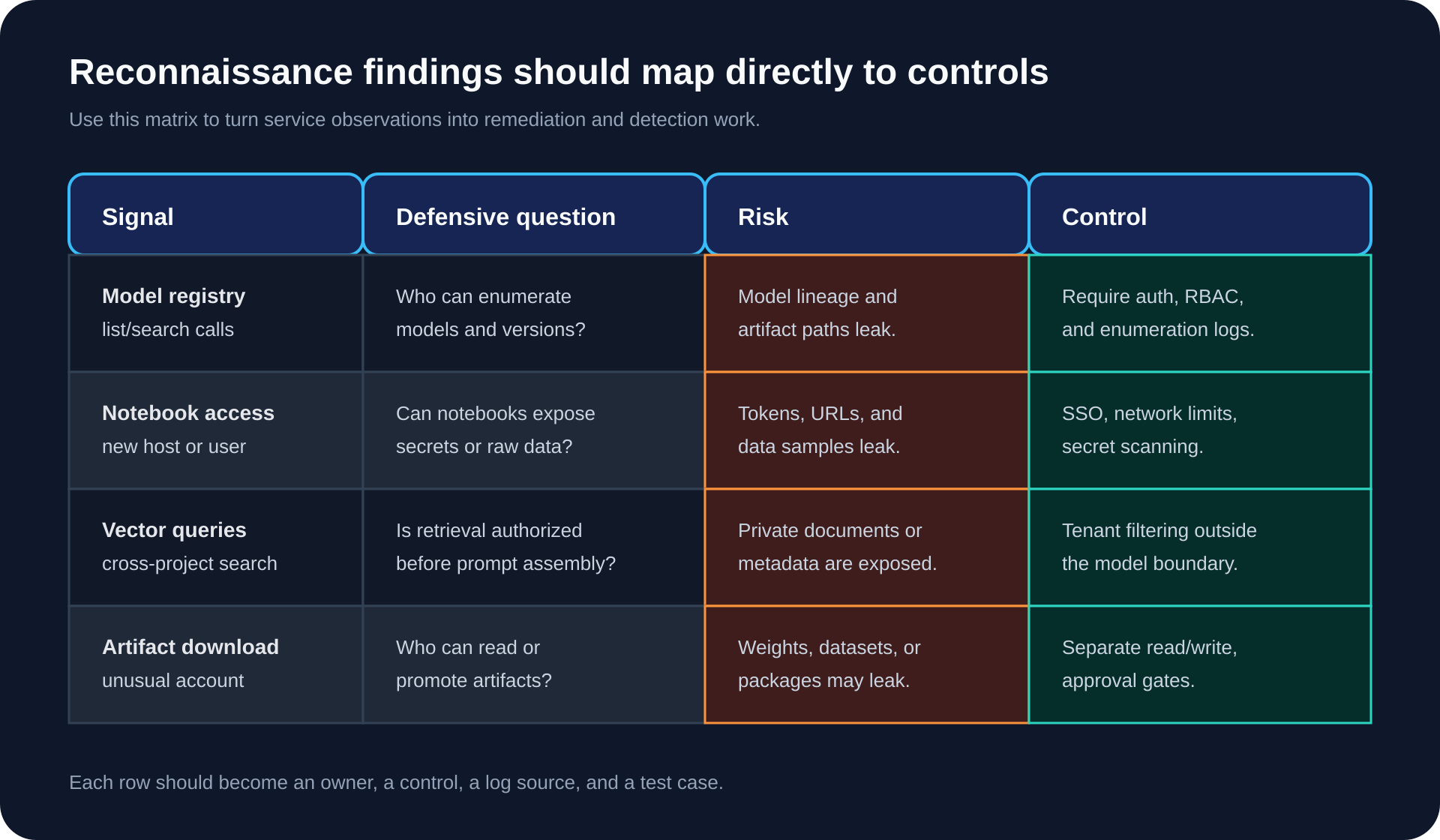
Each component can leak a different kind of clue. The registry may reveal model names and versions. The notebook may reveal internal URLs or workflow assumptions. The vector database may expose document titles or tenant boundaries. The artifact store may reveal whether models and datasets can be downloaded directly.
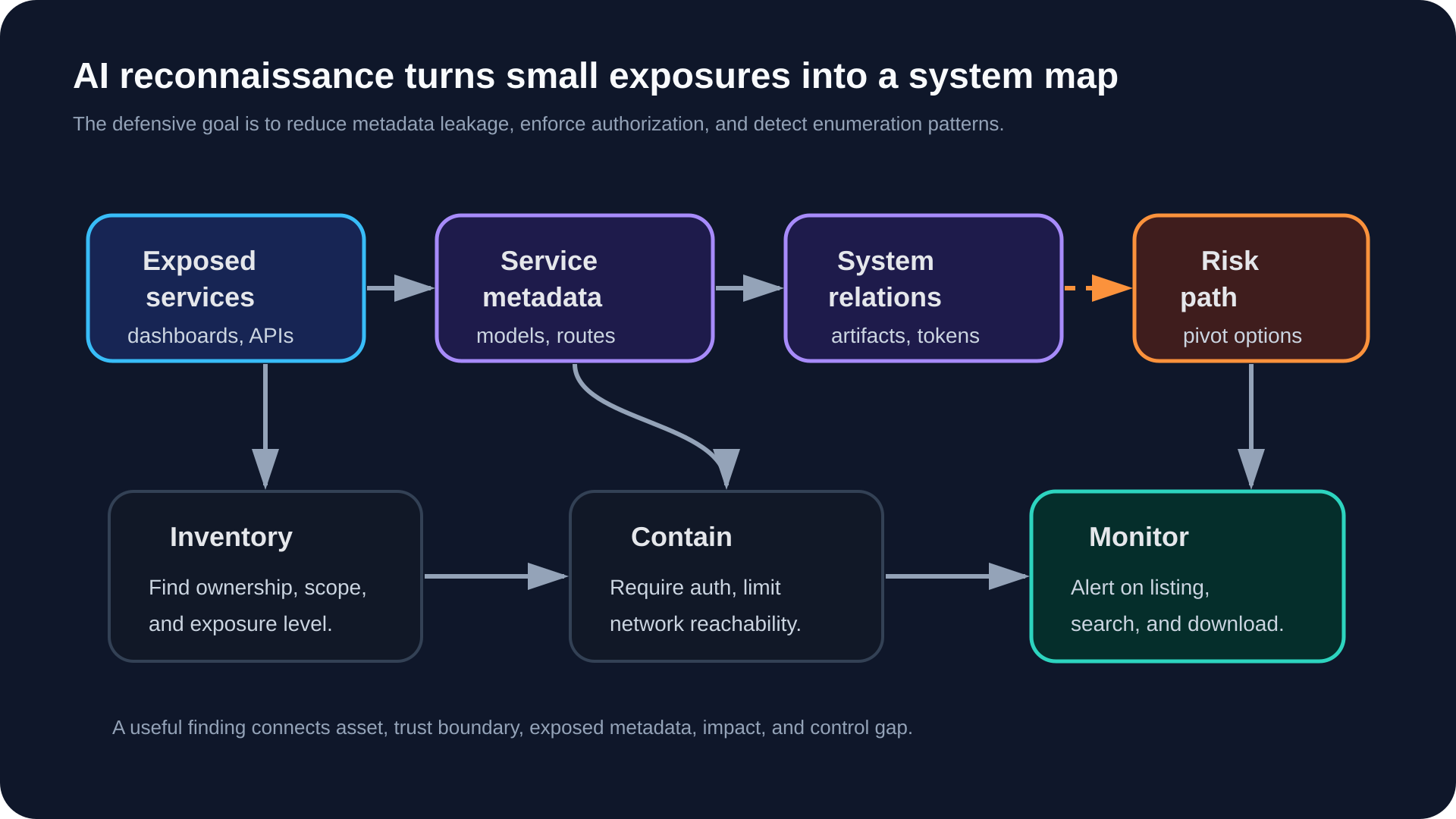
The finding is not just "service exposed." A useful finding connects five things: asset, trust boundary, exposed metadata, likely impact, and control gap.
What I Would Check First
For an authorized internal review, I would start with questions that change remediation decisions:
Can a normal user list model names, versions, or artifact paths?
Can a notebook read production data or production secrets?
Can retrieval return documents across tenants or projects?
Can a service account download artifacts it does not deploy?
Are metadata API calls logged separately from normal UI activity?
These questions are better than a long scanner output. They tell engineering teams what to fix.
A Safe Finding Format
Public writing should not publish credentials, private IP addresses, challenge answers, or proprietary task text. Even internal notes should be written so they can be shared safely.
Service:
Model tracking dashboard

Exposure:
Reachable from the internal user network without SSO.

Observed metadata:
Model names, experiment names, artifact path pattern, package versions.

Risk:
A low-privilege user can map model lineage and deployment dependencies.

Recommended fix:
Require SSO, restrict dashboard access by group, remove public artifact path exposure, and alert on direct API enumeration.
That is enough to drive remediation without turning the report into a walkthrough.
The Controls That Matter
The fastest win is authentication plus network restriction. Put AI dashboards, tracking servers, and notebook services behind SSO. If a service is only needed by CI/CD or a deployment system, it should not be reachable from general user networks.
The second win is permission separation. Reading a model, writing a model, and promoting a model should not be the same permission. Artifact storage should be private by default. Promotion to production should create an audit event and require an approval path.
The third win is token hygiene. Notebooks should not hold long-lived tokens. If a notebook needs access to a registry or bucket, give it short-lived credentials scoped to that workflow. Clear outputs before sharing notebooks and scan for secrets before storing them.
For retrieval systems, authorization has to happen before content enters the prompt. The model should not decide whether a user can see a retrieved document. The application should filter by tenant, project, user, and document permission first.
Detection Signals
Reconnaissance leaves patterns. The exact tool name matters less than the behavior:
registry list/search calls without normal UI activity
repeated schema or metadata requests
gRPC reflection from unusual hosts
notebook access from a new network location
artifact downloads by accounts that do not deploy models
vector database queries across projects or tenants
bursts of model, experiment, or version enumeration
If I had to choose only one alert, I would start with model registry enumeration from accounts that have no deployment role. That signal is specific enough to investigate and close enough to the AI supply chain to matter.
Framework Mapping
Use frameworks to make the finding legible:
MITRE ATLAS for AI-specific adversary behavior such as reconnaissance, discovery, model access, and supply-chain concerns.
OWASP Top 10 for LLM Applications 2025 for prompt injection, sensitive information disclosure, supply-chain risk, excessive agency, and insecure output handling.
NIST AI Risk Management Framework and the NIST Generative AI Profile for governance, measurement, and operational risk management.
The framework is not the article. It is the translation layer between a technical observation and a risk conversation.
Publishing Safety
For public articles about AI reconnaissance:
use fictional examples and sanitized service names
avoid third-party challenge answers or proprietary task text
remove IPs, flags, tokens, passwords, and private hostnames
avoid screenshots that reveal private lab material
cite official documentation and security frameworks
explain authorization and defensive purpose
This also keeps the article aligned with the repo's Medium and Substack publishing rules.
Human Authorship Check
I tightened this article using the human-authored Medium guide in this repo: fewer generic lists, more concrete defensive judgment, and no attempt to publish a challenge walkthrough. The article now stands on its own as a short security note rather than a broad generated-style guide.
Conclusion
AI reconnaissance is metadata work. Defenders should assume that model names, artifact paths, schemas, notebook outputs, vector index metadata, and service-account behavior all have value.
If a low-trust user can map those relationships, the system is already leaking operational intelligence. The practical fix is not glamorous: authenticate the AI stack, reduce exposed metadata, separate permissions, clean up tokens, and alert on enumeration.